I Asked the Regulator: What Limits Fire District Taxes?
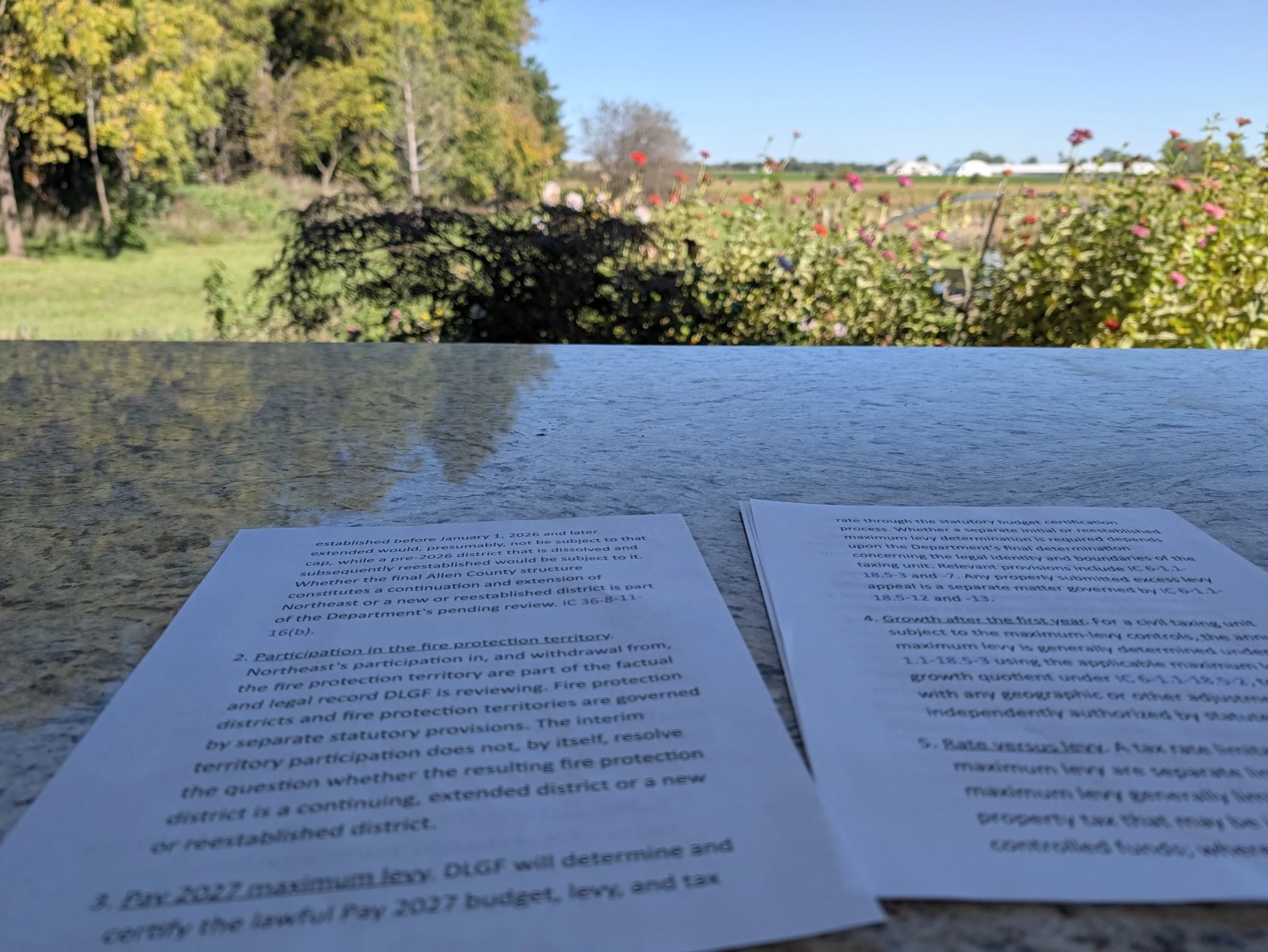
Sitting on The Patio with the actual paperwork. I'd rather read the source than repeat what someone told me.
Lately I keep hearing "I talked to someone important and they said." Maybe so. But none of us can check what was said in a conversation.
So I went to the source. I didn't ask a fire chief or an elected official, and I didn't ask either side. I wrote to the Indiana Department of Local Government Finance (DLGF), the state agency that reviews local tax rates and levies, and asked how the rules apply to the Allen County Fire & EMS District. Their reply is reproduced in full at the bottom of this post. It is DLGF's general guidance, not a final ruling, and the reply says so.
What is happening on January 1
Northeast Allen County Fire Protection District was created before 2026. This summer, the County Commissioners passed two ordinances. One renames Northeast as the Allen County Fire & EMS District. The other amends the original formation documents to bring in the other fire districts, the East Central territory, and several townships, effective January 1, 2027. The county's attorneys chose this route over dissolving everything and starting a new district, because it is a simpler legal process.
A tax bill has two parts
The levy is the total dollars a unit collects. The rate is the levy divided by assessed value. Indiana limits them separately.
What DLGF told me
The maximum levy limits the property tax a unit can impose. A rise in assessed value does not, by itself, let a unit exceed it.
The maximum levy generally grows each year under a state formula.
Anything above the ordinary maximum needs its own legal basis, such as an approved excess levy appeal. A referendum is not a general way to raise an operating maximum levy.
What is not settled
A 2026 law caps the rate for fire districts established after 2025. DLGF's guidance says a district that existed before 2026 and was later extended would presumably not be covered, while one dissolved and re-established would be. Whether this district counts as an extension of Northeast or a new district is part of DLGF's pending determination. They haven't decided, so I won't guess.
What I'll be watching
DLGF's final determination on which kind of district this is.
You shouldn't have to take anyone's word on how your tax bill works, mine included. Read the sources and ask your own questions.
The short version
The district can only collect so many tax dollars a year. That's its maximum levy.
The maximum grows by a set state formula. Higher home values alone don't raise it.
Your tax rate comes from dividing those dollars across the district's property value, so the dollar limit helps keep the rate in check too.
Whether a separate cap on the rate applies is still being decided by the state.
The actual amount depends on a budget that hasn't been approved yet.
Sources: DLGF memo, "Legislation Affecting Fire Protection and Emergency Medical Service Funding Matters" (June 3, 2026) · IC 36-8-11-16 · Allen County ordinance · DLGF's reply
My questions to DLGF.
Jim Smith
Subject: Question on IC 36-8-11-16(b) and the Allen County Fire and EMS District
To: DLGF · Mon, Oct 5 at 12:43 PM
Mr. Lucas and Ms. Culy,
I am a property owner in Allen County, Indiana, and I read DLGF's June 3, 2026 memo on HEA 1210 with interest. I have a question about how it applies to the Allen County Fire and EMS District, which begins operating January 1, 2027.
The Allen County Commissioners passed ordinances on July 10, 2026 that rename the Northeast Allen County Fire Protection District as the Allen County Fire Protection and EMS District and amend its formation documents to bring in the Northwest, West Central, and Southwest districts, the East Central territory, and Jackson, Madison, and Monroe townships. The Northeast district was established before January 1, 2026. It was not dissolved and re-established.
I would appreciate your guidance on the following:
1. Is the Allen County Fire and EMS District subject to the $0.40 rate cap in IC 36-8-11-16(b), or is it treated as a district established before January 1, 2026 that has been extended?
2. In 2026, the Northeast district joined the East Central fire protection territory by resolution, with its withdrawal effective December 31, 2026. Does that interim step affect the answer to question 1?
3. Will DLGF issue a maximum levy order for the unified district for pay-2027, and what will that order be based on?
4. After the first year, what limits growth in the district's maximum levy?
5. Is there a limit on the total property tax dollars the district can collect in a year, separate from the rate? When assessed values rise, does the maximum levy fully control total dollars collected? And what can raise the levy above the maximum, such as an excess levy appeal or a referendum?
Thank you for your time. I am glad to be pointed to the relevant statute or guidance if that is easier.
Sincerely,
Jim Smith
Grabill, Indiana
Reply from DLGF (received on October 5, 2026).
Rushenberg, Timothy
To: me, and 1 other · Mon, Oct 5 at 1:28 PM
Mr. Smith:
Thank you for your questions and for reviewing the Department's June 3, 2026 memorandum.
Because DLGF's Pay 2027 review of the Allen County Fire & EMS District remains pending, I cannot provide a final Allen County-specific determination before the Department completes its statutory review. I can, however, clarify the governing framework.
IC 36-8-11-16(b). The statute applies the $0.40 rate cap to a fire protection district established by ordinance or resolution after December 31, 2025. DLGF's June 3 memorandum explains that a district established before January 1, 2026 and later extended would, presumably, not be subject to that cap, while a pre-2026 district that is dissolved and subsequently reestablished would be subject to it. Whether the final Allen County structure constitutes a continuation and extension of Northeast or a new or reestablished district is part of the Department's pending review. IC 36-8-11-16(b).
Participation in the fire protection territory. Northeast's participation in, and withdrawal from, the fire protection territory are part of the factual and legal record DLGF is reviewing. Fire protection districts and fire protection territories are governed by separate statutory provisions. The interim territory participation does not, by itself, resolve the question whether the resulting fire protection district is a continuing, extended district or a new or reestablished district.
Pay 2027 maximum levy. DLGF will determine and certify the lawful Pay 2027 budget, levy, and tax rate through the statutory budget certification process. Whether a separate initial or reestablished maximum levy determination is required depends upon the Department's final determination concerning the legal identity and boundaries of the taxing unit. Relevant provisions include IC 6-1.1-18.5-3 and -7. Any properly submitted excess levy appeal is a separate matter governed by IC 6-1.1-18.5-12 and -13.
Growth after the first year. For a civil taxing unit subject to the maximum-levy controls, the annual maximum levy is generally determined under IC 6-1.1-18.5-3 using the applicable maximum levy growth quotient under IC 6-1.1-18.5-2, together with any geographic or other adjustments independently authorized by statute.
Rate versus levy. A tax rate limitation and a maximum levy are separate limitations. The maximum levy generally limits the amount of property tax that may be imposed for levy-controlled funds; whereas, an increase in assessed value does not, by itself, permit a taxing unit to exceed its maximum levy. Changes in geographic territory can affect the statutory maximum levy calculation. Additional property tax authority above the ordinary maximum must have an independent statutory basis, such as an excess levy appeal approved under applicable law. Debt service and other specially authorized levies may be governed by separate statutes. A referendum likewise is not a general mechanism for increasing an operating maximum levy; rather, its effect depends upon the specific statute authorizing the referendum.
DLGF's June 3 memorandum is available on the Department's website under 2026 Memos, "Legislation Affecting Fire Protection and Emergency Medical Service Funding Matters." The Department will apply the current statutes and the completed administrative record before making any final Allen County-specific determination.
Very Respectfully,
Timothy J. Rushenberg
General Counsel
LEGAL NOTICE: In my capacity as General Counsel, I represent the Indiana Department of Local Government Finance ("DLGF") and, as applicable, the State of Indiana — not individual employees, local officials, taxpayers, or other recipients. Communications may contain information protected by the attorney-client privilege, attorney work product doctrine, or other applicable law; this notice itself does not create or expand any privilege or exemption from disclosure under Indiana law. Any property tax, local income tax, or other tax guidance provided to persons outside DLGF is furnished in DLGF’s governmental and administrative capacity and does not constitute individualized legal or tax advice to the recipient.